

National Security Innovation Funding Pathway
When most people think about defense innovation, they imagine a large prime contractor inventing the next generation of military technology inside its own laboratories. While that certainly happens, it is only part of the story.
Today’s defense innovation ecosystem is far more collaborative.
Prime Contractors
Large defense contractors still excel at developing and integrating massive, complex systems such as aircraft, ships, missile systems, and advanced communications networks. These programs require decades of engineering expertise, sophisticated manufacturing, and the ability to integrate thousands of individual technologies into a single operational capability. But the pace of technological change has accelerated.
Artificial intelligence, autonomous systems, advanced sensors, robotics, cybersecurity, and software evolve far faster than traditional defense acquisition cycles. Rather than developing every emerging technology internally, prime contractors increasingly rely on partnerships, strategic investments, and acquisitions of innovative startups that are pushing the boundaries of what is possible. This creates what can best be described as a hybrid innovation model.
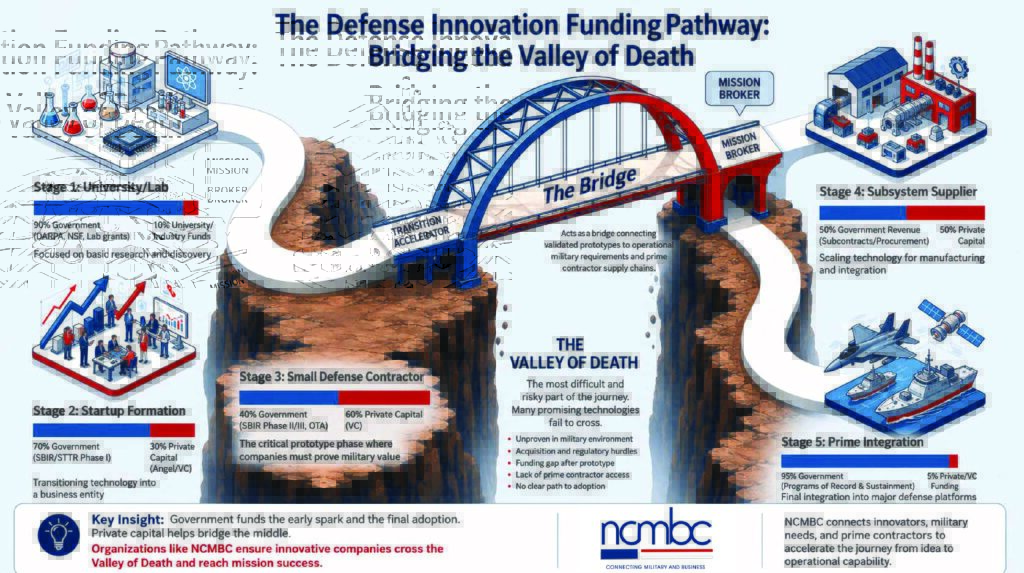
Some innovation is generated organically inside large defense companies. Some originates in universities, federal laboratories, and entrepreneurial startups. Success depends on bringing these different sources together at the right time. The funding behind this process follows a predictable pattern.
Early-stage funding
In the earliest stages, government investment is the primary catalyst. Organizations such as the National Science Foundation, DARPA, the military research laboratories, and the Small Business Innovation Research (SBIR) and Small Business Technology Transfer (STTR) programs provide the resources needed to move promising ideas from the laboratory into early prototypes.At this point, private investors are often reluctant to participate. There is usually no proven customer, no established market, and significant technical risk.
Technology matures
As the technology matures, the funding model begins to shift.Venture capital, angel investors, and private equity become increasingly important as companies work to commercialize their innovations and demonstrate that they can solve real-world problems. Programs such as SBIR Phase II, Phase III, Other Transaction Authorities (OTAs), and organizations like the Defense Innovation Unit (DIU) help bridge the gap between research and operational testing.Yet this is where many promising technologies stall.
The innovation itself may work perfectly, but success in defense requires much more than a successful prototype. Companies must navigate acquisition regulations, cybersecurity requirements, manufacturing challenges, testing, validation, and integration into existing military systems.
The “Valley of Death”
This gap has become known throughout the defense community as the “Valley of Death,” and you need a bridge to get across it.It is not a failure of technology. It is a failure of transition.Moving from a successful demonstration to an operational military capability requires trusted relationships, experienced guidance, and access to the organizations responsible for fielding new capabilities.
NCMBC’s Technology Transition Office
This is where the NCMBC Technology Transition Office plays a unique role. Rather than serving as another research organization or investment fund, the NCMBC functions as a transition connector.
As an entity of the state of North Carolina, Its purpose is to help North Carolina companies navigate the complex journey from innovation to adoption by connecting researchers, entrepreneurs, defense contractors, military organizations, acquisition professionals, and prime integrators into a single collaborative ecosystem.
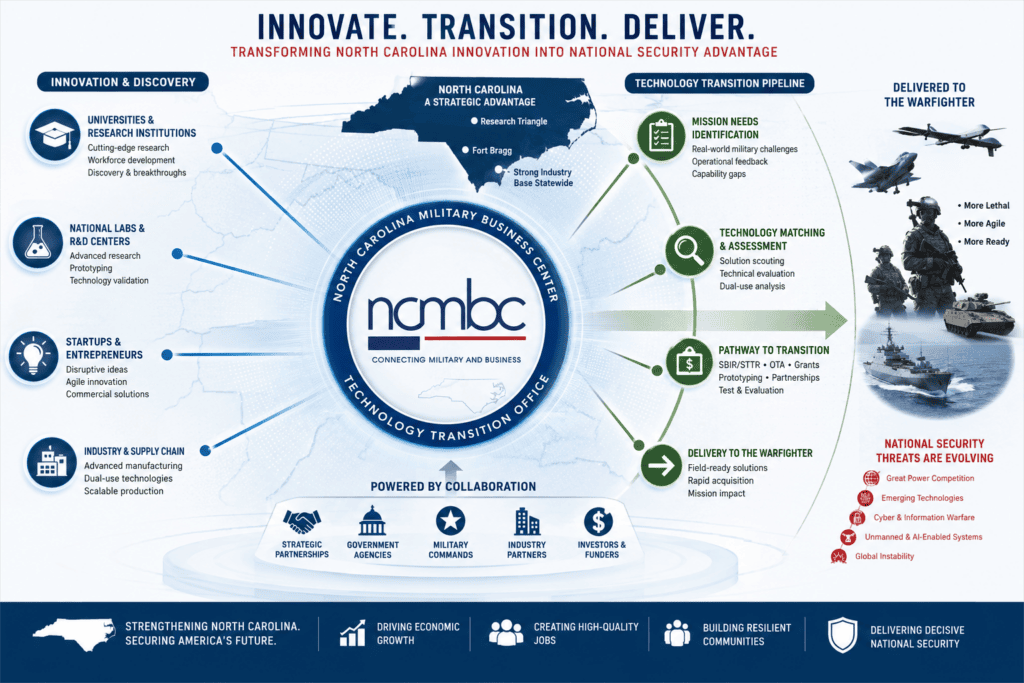
The NCMBC helps companies identify defense requirements, pursue appropriate funding opportunities, establish relationships with military customers, and connect with the prime contractors responsible for integrating new technologies into larger defense systems.In many ways, it serves as the bridge across the Valley of Death.
Instead of asking, “How do we create more innovation?” the better question becomes, “How do we move existing innovation into the hands of the warfighter faster?”That shift in thinking changes everything.
North Carolina already possesses world-class universities, nationally recognized research institutions, innovative startups, major defense contractors, and one of the largest concentrations of military installations in the United States. The challenge is not a shortage of ideas or talent.The challenge is connecting them.
When the right partnerships are formed, promising technologies move more quickly from university laboratories to startups, from startups to defense suppliers, from suppliers to prime contractors, and ultimately into the hands of the men and women who defend our nation.
The future of National Security innovation will not be determined by a single organization acting alone. It will be determined by how effectively the entire ecosystem works together.
Innovation creates possibility. Technology transition creates capability. The purpose of the NCMBC’s Technology Transition Office is to assist promising innovations from North Carolina research institutions and businesses continue their journey until they become operational solutions that strengthen our national security.
For additional information about Innovation Funding, watch the short video below:
 PRINT
PRINT